M-1 Pierre Le Manh 氏 「Project Managers: Key Drivers of Digital Transformation プロジェクト・マネジャー:DX推進の主要原動力」 PMI President & CEO
Pierre Le Manh:
Hello, everyone. Hello, Hayama, and thank you. It is my absolute pleasure to be here today with our PMI Japanese community, our successful PMI Japan community, to talk about the role and expectations from project managers of today, of course, but also of tomorrow that are driving digital transformations. The acceleration of change that we live in presents many challenges, whether it is working in a hybrid environment or with multicultural teams. But let me get this straight. Agility, paired up with lifelong learning, is the pathway to success. Now before I get started, I would like to begin by congratulating all of you for being here, for being part of this community, and for continuously upskilling yourselves to stay on top of your game, ready for what the future will bring. I am myself a product of globalization. I am a dual European and American citizen of Asian descent. I was born in France, and I grew up in a bi-cultural European and Asian family from a Vietnamese father and a French mother. I then lived and worked in multiple countries, in Canada, in the UK, in Italy, in France, of course, and I have now lived in the US for more than 10 years. So having spent many years in a very international environment, I have learned to value global communities, the power of global communities, as they have so much to offer. And that’s also one of the reasons why I feel so happy at PMI, which truly is a global welcoming and inclusive organization. And meeting you today means a lot to me. I am getting to know another part of our global PMI family, the PMI Japan chapter. And hopefully soon we’ll find an opportunity to meet in person as well during one of my next trips.
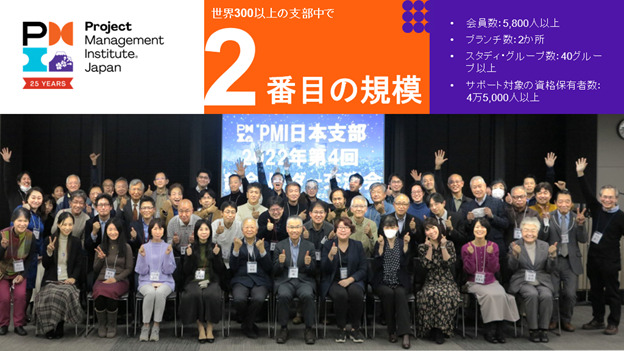
This year, the Japan chapter celebrates its 25th anniversary. And I am thrilled to see how the PMI Japan chapter has worked so hard to promote project management as a profession. Let me name and recognize a few of your achievements. You ae the second largest of our more than 300 PMI chapters worldwide with more than 5,800 members. which comes right after the largest one, Washington, D.C. PMI Japan chapter has two branches, each one larger than many of the chapters we have elsewhere in the world. There are more than 40 study groups and communities that have been actively promoting project management in Japan over the last 25 years. On this picture, you can actually see some of them. This picture was taken during the 2022 Japan Chapter Study Group meeting. You can tell how happy they are to be able to gather in person again and connect and network. The chapter is supporting more than 45,000 certification holders, of which 44,000 are PMP holders, but it’s also over 500 CAPM and over 400 PMI-ACP holders. The chapter is making sure our certification holders are presented with many opportunities to upskill and to renew their credentials. All of this is happening thanks to your dedication and volunteering, for which I would like to thank you from the bottom of my heart. So today, we will talk about how we can transform the future of Japanese organizations, how we can make them digital, and equally importantly, how we can make them more nimble and capable of dealing with digital disruption. Of course, we’re not talking here about the most recent digital native companies or startups that are built on a technology platform that disrupts an industry by… delivering value in a different way or cheaper way. But the ones, the organizations that have had a successful business, but need to transform proactively to leverage digital disruptions. And in many ways, it is a more difficult and more complex task. So this should be a great discussion and I would like to use this opportunity to thank SoHyun Kang, our APAC Regional Managing Director for choosing this very important topic. So thank you, SoHyun.
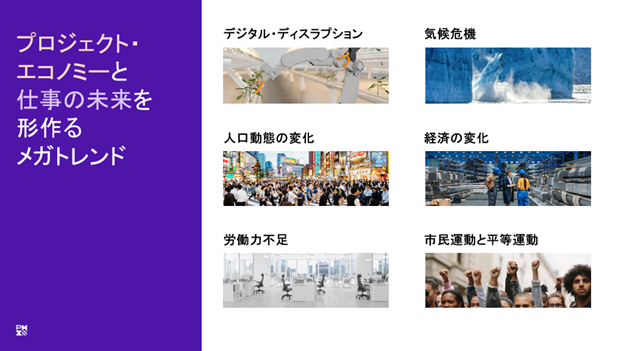
So let’s start with the context of corporate transformation. What you see here on this slide are the megatrends identified by PMI in our latest annual megatrends report. The report highlights six major themes, digital disruption, climate crisis, demographic shifts, economic shifts, civil, civic, and equality movements. Of course, megatrends are always a simplification. They do not all affect everyone, every company, or every industry on the planet to the same extent. But, they are still very important contextual elements, and I personally believe it is really worth the time and the effort to understand them. and to reflect on them. On one side, because the present opportunities to contribute as project managers to some of the world’s most pressing challenges would be great if you can work on some or several of these trends, but also because understanding them, having a point of view helps us all be better and more effective at dealing with most of the principles that PMI refers to. In particular, in our latest PMBOK, PMBOK7. Think of risks, teams, stakeholders, system thinking, adaptability, adaptability and complexity, change, of course, and ultimately leadership. All can be better mastered if you understand these societal shifts. Obviously, these trends also represent business opportunities, and most companies have an enormous focus on sustainability, on innovation, on the deployment of technologies. There is no way to slow down the world, of course. The key for growth, whether we talk about personal or business growth, is really getting out of our comfort zone. I always say, growth and comfort do not go well together. So success is in adaptation and reinvention. Or in other words, success is in our ability to look around us with a fresh set of eyes. Stay open-minded and be flexible. Because adapting, embracing, and ideally leveraging these profound societal trends requires operating with a perpetual transformation mindset.

So let’s dig a little deeper in the first mega trend, which is, not surprisingly, digital disruption. And this affects a number of areas that form the most powerful innovation platforms of the world. Think of robotics, or energy storage, or AI, of course, or genomic sequencing, or Blockchain technology. All these technologies will affect every aspect of the global economy, of how organizations or entire industries operate, how we as people interact, how we live as individuals and collectively as societies. Now, what is truly extraordinary, if you think about it, at the heart of all of this digital disruption, who do we find? Who do we find? Well, the answer is simple, at least for us. The word digitalization is led by experienced, seasoned, hardened, and knowledgeable project professionals. Whatever their titles are, I was recently checking the state of the jobs report that is annually issued by the World Economic Forum. The digital transformation professions are. not surprisingly, listed among the fastest growing jobs. So I see an incredibly bright future for our profession. Our ability to turn ideas into reality, as we say, to problem solve, to rally teams around changing and evolving objectives, to support innovation, to manage risks of all sorts, including very uncharted ethical risks, privacy risks, is why project professionals are so essential. Now, as often, life is not black or white. Changes and opportunities are two sides of the same thing. They are the two faces of change. I am saying this because none of us is immune to the pressure stemming from always increasing expectations. We feel that pressure all the time. And that pressure is driven by the digital transformation of industries. and by the possibilities that the vertiginous acceleration of data availability has opened. And as a result, our stakeholders want fast answers. They want fast reactions. They want rapid adjustments of our offerings and customer experience improvements, literally on the go. That is why our broader perspective of the world around us matters, because it helps us see the opportunities in every threat.
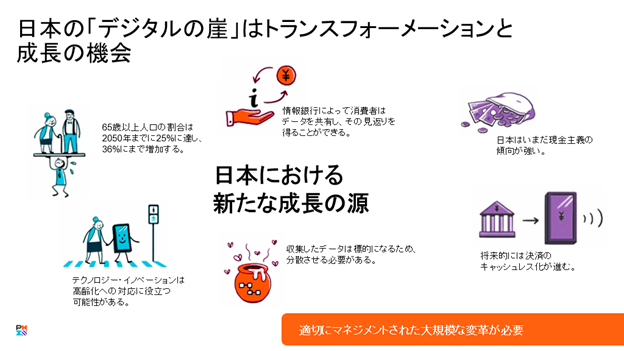
For a few years now, as you all know, of course, Japan has been referring to its digital cliff. Japan’s digital cliff is a huge challenge that many of you are engaged in today, but which, as Japan will address it over time, will generate new sources of growth for the country and for its businesses. Now Japan has the opportunity to leapfrog other countries on many fronts. Let me give you a few examples. Respectful and helpful support for aging citizens could become a reality for a larger part of humanity. World-class security for data could be applied across the board as new infrastructure is led in. Payments could not only be streamlined, but revolutionized. So that makes me feel very excited for the prospects for the future of Japan and for you project professionals who will actively contribute to all of that and me on many other challenges.
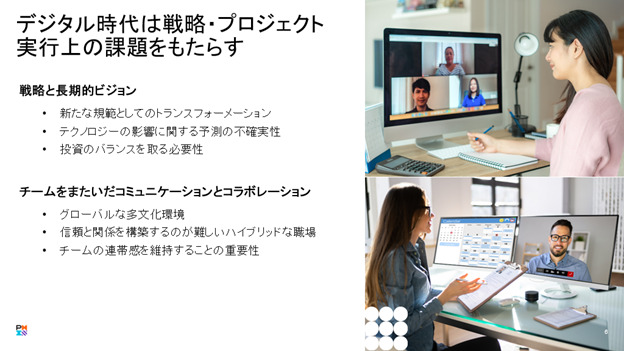
You know, project management is a hard discipline. I think we all know that. And as such, it does deserve a lot of admiration. When it comes to digital transformation, like for any projects, there is never a shortage of technologies for project managers to overcome. I picked a couple here that I find typical. So for instance, in the digital era that we are in today, transformation has become more than the norm. It has even become a philosophy. a lifestyle. And as much as we invest in learning and in technology adoption, it is hard to predict all the impact to come while at the same time we have pressure to develop solutions that can last and will produce long-term value. So think about, for instance, the case of generative AI. There’s a company, Salesforce, that recently found that 67% of senior IT leaders, 67%. are pushing to adopt generating AI across their businesses in the next 18 months. Even one third are naming it their top priority. One third. But at the same time, a majority of these senior IT leaders have real concerns about what could happen. Among other reservations, they say, the report found, that 59% believe generative AI outputs are inaccurate. And we’ve seen… pretty interesting examples of that lately. And 79% have security concerns. So you see all these factors make it very challenging to set the strategy. Because it basically forces us to plan in much shorter iterations and to constantly adapt. So as a consequence, it is even more important to have a north star. This direction, the vision. Yeah, we call it the north star, at PMI and to communicate it, to have something that guides and unifies teams, the purpose of our efforts. But even finding that North Star is not an easy task. As a CEO, I always appreciate when people ask me, why? Why are we doing this? Why are we doing it this way? Why not that way? Asking these questions helps you, project professionals, but also your leaders, to assess if everybody on the team understands the purpose. or not, and it gives the opportunity to clarify this thinking going forward. It is also very important to always challenge the status quo, even if this is not necessarily what human beings are the most comfortable doing or what culturally we are comfortable doing. But without challenging the status quo, without trying to do things better and differently, there is no real transformation that is possible. That is why I do understand IT leaders who say they want to embrace generative AI even without being totally sure of all of the consequences. As long as they do it in short iterations and readjust. You know, it is great to refuse the comfortable position of just waiting and seeing. With a North Star and a very structured but also very iterative approach, they will maximize their chances. to succeed. There are also many challenges on the project execution side. I remember that at the beginning of the pandemic, some were saying that the world would be totally different after the pandemic. Do you remember that? The world would change completely. It won’t be the same world. At the same time, others were saying that things will very quickly revert to the norm. They used, for instance, the example of air transportation that reached record highs. not that long after September 11 in the U.S. Just to illustrate that, in spite of a massive shock, things revert to normal pretty quickly. Now, in fact, both camps ended up being right. Many things are very much back to normal. But what has changed is that we have demonstrated on a global scale that many jobs, especially jobs that pertain to the knowledge economy, and that is most jobs in the richest nations can be done remotely, in spite of a few challenges, of course. So at PMI, for instance, this has had a consequence, a huge consequence. Instead of recruiting 90% of our employees in the Philadelphia area, where our headquarters used to be, which was obviously very limiting in terms of size and diversity of the town pool. And by diversity, I mean diversity of culture, diversity of thinking. Now, we have totally lifted. geographical constraints for most jobs because we are now fully remote. So we are not only recruiting a very small share of our people from the Philadelphia area. And although our employee base is still a majority US based, we have an increasing proportion of non-US based employees, even in global roles. It does have, it changes for sure, but that’s a huge change. And it’s the same in many companies, especially when it comes to teams involved in digital transformation. Thanks to technology, teams are more global. And because they’re more global, they’re also more multicultural. And that is not always easy. I’m sure that many of you work with US or European colleagues or colleagues from other regions of the world. And you know what I mean. Cultural understanding starts with self-awareness. of our own norms and how they may not fit or resonate with the norms of others. I personally spend a lot of time on that, trust me, and I believe it is very important to spend enough time observing, researching, and learning cultural biases, starting with our own. Then running projects in remote or hybrid environments obviously brings a whole set of communication challenges that I am sure many of you… have experienced, for example, figuring out the best way to share information across team members who are dispersed over the world and time zones, how to ensure that everyone is on the same page and stays engaged and motivated. Another issue is that it is easy for team members to disengage without others really noticing or worrying about it that much. Or sometimes we work with people who have never met face to face, yet we need to be able to build trust, to create teamwork and a sense of cohesion. All these changes are still fairly recent for many project managers and for many executives. And that’s another reason why it makes me so happy to see the picture of the study group that we showed before, to see people meeting and mingling again, so that they can share their experience and support each other. In the end, I believe that the future of knowledge work will be one where maybe about half of the savings that will be made in real estate costs, coming from reducing office space, will be reinvesting, reinvested in building teams’ cohesion, including meeting face-to-face, offsite, once in a while, to foster bonding and mutual trust. Now, I know that some heavily publicized, en masse layoffs in the Silicon Valley have generated some anxiety about job security in tech. Although interestingly, in spite of fairly gloomy economic predictions, unemployment in the G7 countries, and of course, starting with Japan and the US, is at a record low. But even in tech, Whomever is involved in digital transformations is very safe, honestly. And even if something bad happens in their company, they are very employable.
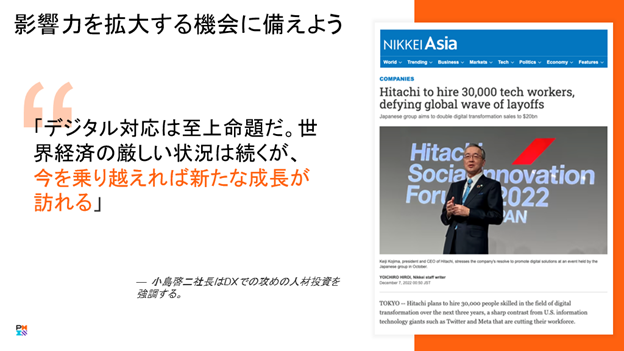
In the end, what is exciting for project managers is that digital transformation is an exceptional opportunity to have great impact. I’m sure that all of you saw this headline at the end of last year. Hitachi is hiring 30,000 people to drive transformations over the next three years. And that’s… Just one example, but it really should make you feel very marketable as a product professional, very much in demand, especially if you have a PMP. Note that President Kojima feels that new growth will arrive when he says, quote unquote, we, that is Japan, overcome the current situation. So the best way to do this is to digitally transform existing businesses, something you are uniquely positioned to do. I look at this not just as additional career opportunities for project managers. That’s already important of course, but it’s also a way to do something meaningful. Together we can not only help Japan regain its leadership position, but we can get the entire world to improve, to be on a better economic footing, and make society more people-centric and more sustainable. Yet project managers need to be equipped to support business leaders on their path to digital transformation.
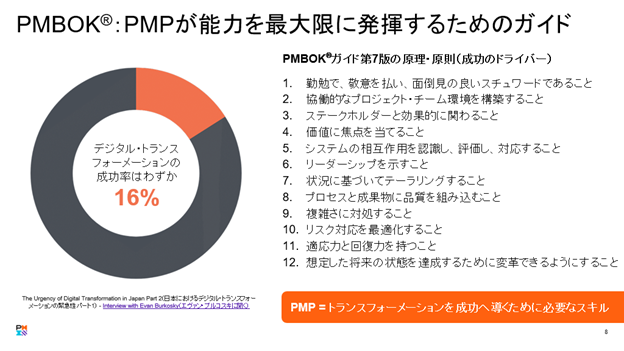
The success rates, as you see on the chart here, are not very high. Our role though in this challenge is clear. PMPs, all of you, are perfectly positioned to make these numbers better. Some of you may have not opened a PMBOK guide for years. I do recommend though that you take a look at PMBOK 7 because… It covers very important principles. I mentioned some of them earlier. These principles transcend any methodology, whether you use agile, predictive, lean, DevOps, Kanban, et cetera, it doesn’t matter. They are all principles that are designed to help you shape your approach and support your success. Now, to name a few of them, the first principle says be a diligent, respectful, and caring steward. Following this principle will quickly increase your influence. It is one major key to your success. Project managers are encouraged to be good project stewards. With digital transformations, technology is ever-changing, so the program may need to shift gears dramatically to achieve the original intent. A caring steward will make the right decision at these inflection points. They will also responsibly manage and safeguard the organization’s digital assets, data, and technologies. They will ensure their integrity, privacy, and compliance with regulations and industry standards. Now the second principle is create a collaborative project team environment. So in summary, it’s not about me, it’s about we. When we collaborate with our project team, we work together to achieve the project’s objectives. Digital transformation requires cross-functional collaboration, knowledge sharing, and iterative problem solving that enables effective alignment and integration of digital technologies and processes across different departments and teams. Now, the third one, effectively engage with stakeholders, is about understanding that everyone needs to know what’s in it for me. Digital transformation requires actively involving stakeholders from different levels and functions. In the planning. decision making and implementation processes, so as to ensure their input, support and commitment to the digital transformation journey. So I could continue like this for each of the 12 principles, but I think you got my point. Again, I encourage each of you to read the PMBOK7 and to reflect on it, unless you’re already doing this every day. But reflecting on it based on your experience, it’s what is the most important thing. The role and expectations from project managers changed over the past decades. PMBOK is continuously being updated based on research conducted to understand how to make project professionals successful, how to increase the value delivered by projects, and ultimately how to create bigger impact, whether we talk about business, outcomes, or society.
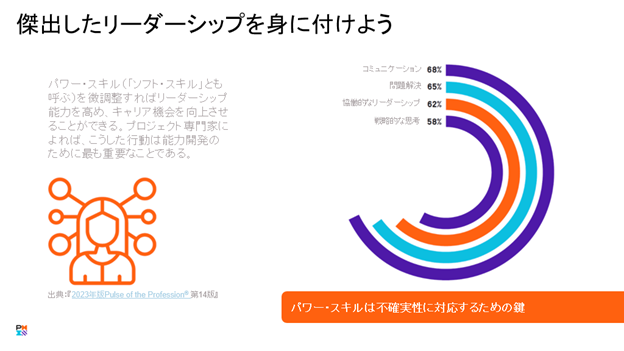
I would like to mention another important research that is captured in the 14th edition of the yearly Pulse of the Profession that is published by PMI. The report talks about power skills. I’m sure you’re all aware of what power skills are, right? It explains how project managers can stand out by applying these power skills in their daily work. The most important power skill identified by the research are communication. problem solving, collaborative leadership, and strategic thinking. Now, unfortunately, of all the skills that PMIs, PMPs typically possess, power skills are in the shortest supply. Being truly great in each of these areas is an incredible opportunity to differentiate, to really stand out as a leader.
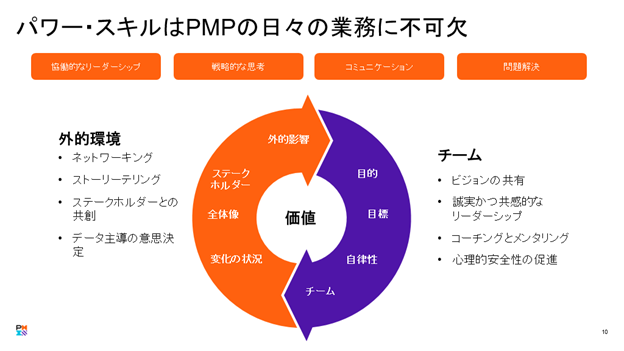
So let me talk about the four top power skills for a moment. Firstly, while communication has always been recognized as a core skill, today it also includes speaking the language of the organization and putting the work in strategic context. Follow the North Star. Tuning your messages to very specific stakeholder audiences. Using new technologies such as ChatGPT to make information more impactful and consumable. Now the second thing is, problem solving, specifically problem solving as a team. By the way, as we teach at PMI in a course called WPS, problem solving as a team is even more important in the unstable, uncertain, volatile environment we all operate in today. And the reason for that is that often today we are handling problems rather than projects. So, Collaboration to refine our understanding of the problem is a perfect way to bond and focus a team together, while at the same time creating solutions that dramatically increases ownership. And the net result is fantastic alignment, extreme alignment even, that would never be achieved through just top down leadership. Now group problem solving also lies at the core of the third power skill, collaborative leadership. So coupled with allowing topic experts to visibly lead in their areas is helping them grow their careers and competency. And finally, number four, strategic thinking is key. It requires a deep understanding of the strategy, especially the intent behind strategy, to see the organization as a system and how your initiative would improve that system in a measurable way and lead to understanding how everything you’re measuring ladders up to specific organizational objectives. So you can easily see how these skills will help PMPs execute more effectively, but also improve performance and lay the groundwork for career advancement. Power skills should be deployed literally every day. Project managers need to deal with the external environment of their project, understand expectations of the stakeholders, see the big picture in which the project fits. But at the same time, they need to make sure that the value of their project is seen and understood, especially when it comes to prioritization and resource allocation. So to achieve such understanding, project managers need to do more or less the same as CEOs do. networking, sharing project story, co-creating with multiple stakeholders, and reinforcing their sense of ownership of project success. Now on the other side, internally with their team, project managers need to lead by sharing the project’s vision, by role modeling, by coaching and mentoring the team members, so as to create the conditions of their own growth and the full utilization of their talents. So I hope I convinced you about the importance of power skills. And I’m also sure that SoHyun and her chapter engagement team will support you in developing these skills if you would need or want to.
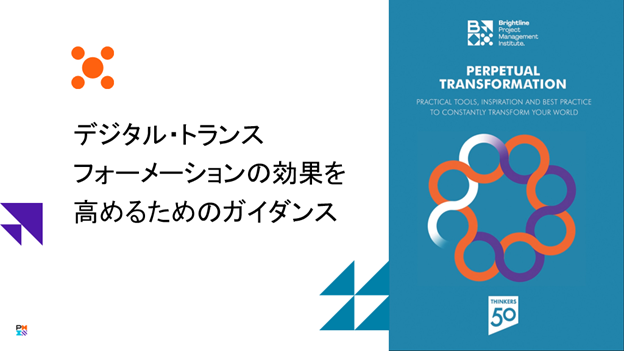
Now, with all of that being said, there is one more source of great learning that I would like to talk about. Through Brightline, our proprietary thought leadership arm, PMI published a really interesting book entitled Perpetual Transformation. As you probably know, the Brightline books are created together with experts, practitioners, and global thought leaders to ensure that they reflect actual experience and real situations. Now when you read the book, Perpetual Transformation, you will see that pretty much all of the topics in the book apply to the digital transformations that many of you are undertaking. So I’ll only cover a select few here, but the whole book is a good read if you are leading a transformation. But I’m also not saying these are the only approach, of course, or a one size fits all solution for transformation. These are just… good practices that have worked for many practitioners before. So my hope is only that some of these ideas will motivate you for further exploration and help you find the right path for the efforts you are undertaking. So let’s get to it.
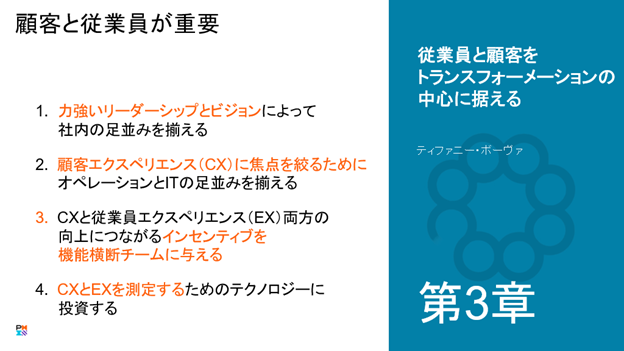
In chapter three of the book, Tiffany Bova describes the importance of putting employees and customers at the heart of transformation. She gives us four points to align with in order to make that happen. One is aligning the company with a strong leadership and vision. So what does that mean in practice? We all know the value of clear communication, but this is more. I talked a few minutes ago about the importance of finding a North Star, the guide or the purpose, if you will, that bonds team together. The point that Tiffany is making here is very similar to that. It is about instilling a common sense of purpose and having everyone understand what’s in it for us. And of course, what’s in it for me. Two is around aligning operations and IT to focus on the customer experience. By the way, we at the Project Management Institute are no exception. One way that we recently applied this approach at PMI was to merge the product team and the tech team. and also the CX team into the same department. So as we refine the integration of these two or three, over time, we expect not only greater efficiency, but also new ideas born out of collaboration. And in general, we expect to increase the connection between our products, our technology, our user experience. So why is that so important? Aligning operations and IT roles gives us both the understanding of customer needs, and the ability to improve their experience within just one team. And I can talk from my own practical experience. When these two groups were disjointed, the understanding of the drivers of customer experience got lost in internal discussions and in IT resource prioritizations and changing priorities. And while honestly, in the end, customers don’t care how we are organized internally. They expect us to communicate. to use data to act fast if something does not work as it should. At PMI internally, we use the concept of cross-functional agile teams that are aligned through PI planning and supported by our EPMO office. Now three focuses on incenting cross-functional teams to work together. This is about creating an effective balance between CX, that is customer experience, and EX. which is employee experience, so that both CX and EX serve to align rather than creating conflict. Four is about measuring both CX and EX, so we all know that you get what you measure. The most common mistake is looking at these two as independent activities. In fact, CX equals EX. It is hard to imagine that any company would achieve true digital excellence only on the outside, customer facing, while their employees would need to work in an environment that is not digitally matured. So looking at CX and EX measures as a system of incentives will create much better outcomes and would reflect in customer loyalty as well as in our ability to retain our best talents. You may or you may not drive all of these activities as a project manager, but at the very least you can cross check. that they are happening and call out areas of opportunity. Thinking and contributing at this level is not only good for your organization, but it’s also critically important for you, for your career, for your next steps.
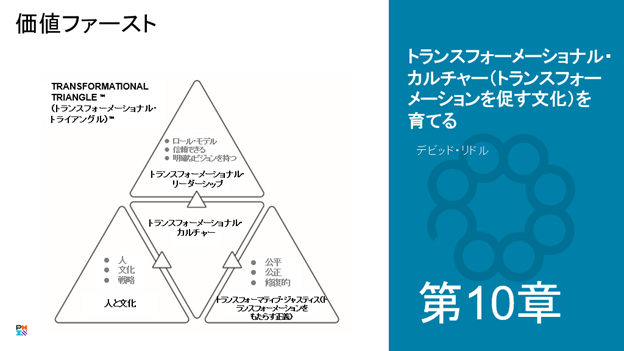
Now, we have all heard one million times the saying that culture eats strategy for breakfast. It’s kind of a platitude, but it is true. Without cultural shifts and mindset change, large-scale transformations will always face difficult challenges. So in chapter 10 of the book, David Little describes how to develop a transformational culture which is fair, just, inclusive, sustainable, and high performing. It is meant as a framework for organizations who are committed to putting their purpose, people and values first. At the top of what David calls the transformation triangle, you’ll see transformation leadership. transformational leadership. Here, he describes leaders that walk the talk, that understand that they are role models for the rest of the organization. Trust and vision are, of course, very critical here. Bottom right, he highlights transformational justice, balancing the needs of employees with the needs of the organization in a way that creates trust. This is about reducing processes that promote conflict. For example, marketing measures should work in concert with sales measures to create growth, but often the two create an atmosphere of blame and retribution that is counterproductive. Now, bottom left, David focuses on people and strategy in a way that he describes as transformational HR. Here he talks about HR being obsessed with employee experience in a way that is a catalyst for customer experience. creating a system where everyone operates together more effectively. This chapter offers a lot more detail on the approach. So I would take a closer look at this if culture seems to be a challenge or if you have an interest in it. At the very least, it will promote some fresh thinking around what matters most. And also giving you the opportunity to contribute at a higher level and utilize your strategic thinking power skills. Again, very good for your organization and very good for you and your career.
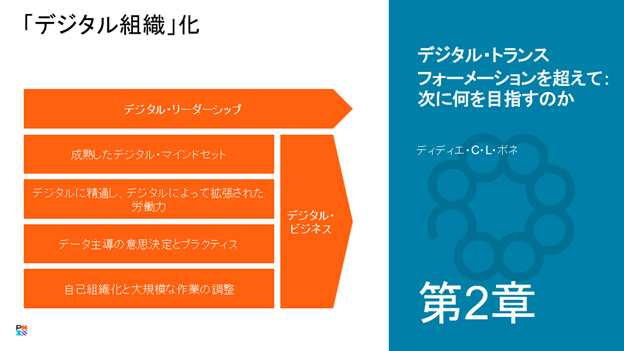
Now, in chapter two of the book, Didier Bonnet is focused on making the act of digital transformation a second nature or an ongoing basis, effectively becoming a digital organization. He believes there is a structural approach to this that is illustrated by this diagram. It is similar to the approach we saw in chapter 10. He describes strong leadership with a clear vision as an important component to going digital. Didier asks you to think about how far your business is from being a digital organization. He offers the following five questions to frame that discussion. One, how far do you think your organization is from having a digital mindset? He talks about a digital mindset where a positive and proactive attitude toward digital possibilities is particularly important. The idea is to challenge the status quo and constantly look at technology as a way to remove traditional operational and competitive constraints. Second, how digitally savvy is your workforce? Are you thinking about how automation can augment the value-added work within your organization? He stresses the need for a digitally savvy and augmented workforce, raising the digital IQ of the organization, promoting continuous learning, and automating work to the degree possible. The way he describes it is similar to the way that we talked about chat GPT. It’s not just about machines replacing humans, but machines augmenting humans. Now another question from Didier is, do you have the data and mindset needed to be data driven in your decision making? Data-driven decision making is something that’s been deeply ingrained in all of us by this point. But Didier effectively asked us to use fact-based approaches more consistently in a digital environment where we have greater access to more facts and data. Another one is, what is the ability of your workforce to self-organize across traditional boundaries? So here, Didier suggests we create self-organizing teams. and orchestrate work at scale. So to enable that is such as that talent has room to move, departments within the organizations have porous boundaries with an ability to quickly access and source talent externally as needed. Staff is autonomous enough to attack opportunities wherever they exist. Internally, digital organizations are able to deploy resources and expertise, flexibility. where customer or operational opportunities exist. And this is also true beyond organizational boundaries. Again, as a project manager, you may not be able to control these efforts, but at the very least, you can cross check that they are happening and call out areas of opportunity. And finally, because I feel this is particularly important when we manage digital transformation, given the pace of technological change and the uncertainty about their impact.
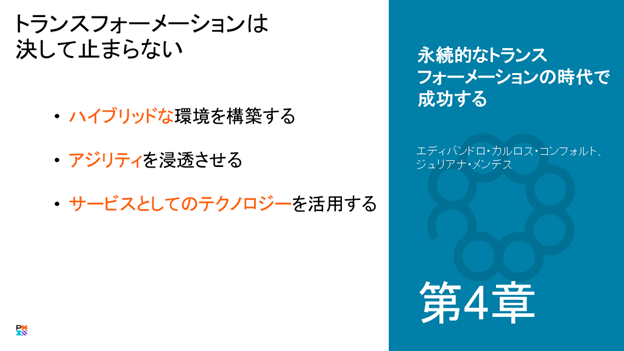
In chapter four of the book, Eddie Conforto and Julianne Mendez describe ways to thrive in that environment. They begin by describing the motivations for both onsite and offsite work and how the two need to play together going forward. The current mix has created the need for adaptive spaces to foster connections, to help teams collaborate, combined with leveraging digital tools that allow workers to participate from anywhere. The specific shape these spaces take or will take will depend on your business objectives and on the technology available at the time, which is constantly evolving. Then they also discuss agility in a way that goes far beyond agile methodologies. They recommend to be driven by principles and tuned to your organization’s needs, strongly connected to strategy. They recommend to scale holistically through design thinking and not just IT, but also stay connected with the business ecosystem. They recommend to allow for external collaboration and be continuously measured so benefits are well understood. And now finally, they also recommend leveraging technology as a service. keeping systems very cloud-based, modular, scalable, adaptable, so as to unlock growth and innovation. They also urge us to, as they say, mind the talent gap. Good expression, mind the talent gap.
I would like to conclude saying that there are times when technology is evolving so quickly that it creates new, unforeseen opportunities for almost every business. We are in one of these times now with generative AI. we will see AI opportunities become very pervasive. And many businesses will have trouble, difficulty keeping up. I believe that the points I covered can be very valuable in helping you make the best of this major disruption. That will, in my opinion, at least, drive another era of digital transformation. I hope it will help you seize the opportunity it presents for yourselves as project professionals in your careers. help your organizations be the winners, and more broadly, I hope it would present an opportunity for you to keep living a fulfilling and meaningful life and career, contributing to a better society and a more sustainable world. So that’s all for me. Thank you for listening, and I hope we will stay in touch, as I am very excited to hear your stories about successful digital transformations under your leadership.
**
SoHyun:
Thank you, Pierre, and good morning, everyone. Good morning, everyone. Pierre, thank you for sharing your insights on how important the role of project managers are to drive transformation in Japan and beyond. As a PMI Asia Pacific Regional Managing Director, I’m so delighted to have you as the keynote speaker for our APEC’s largest chapters. largest event PMI Japan Forum today. On behalf of our chapters, event organizing committee, volunteers, staff and Hayama-san, I’d like to thank you for your speech and message once again. Now we’re thrilled to have some time for us to have a deep dive conversation. And I’d like to ask you first question. So as I listen in your speech, it’s clear that there are a lot of huge opportunity for project managers. Can you share more details on PMI’s product roadmap that could help project managers in this era of transformation?
Pierre Le Manh:
Sure. Thank you for the question, SoHyun. And great to be with you, as always. So first of all, when we talk about product roadmap, we talk about products. And usually, when people think about products, when it comes to PMI, they think about courses or certifications. But like I love to say, what PMI is, is truly a flywheel. So we’re a system of multiple components when pushed in the same direction and functioning in coordination, deliver all the value of PMI. And that system is more than just courses or certifications. You, as chapters, are a big part of that experience that PMI provides, of course, because through the connections, through the courses, the events, an event like today, this is not a product in the sense of a course or certification, but it does contribute to connecting together. to learning and in the end to give back to each other. So that’s what we do at PMI. And I really think it’s important when we think about the product roadmap that we don’t limit ourselves thinking in terms of certifications or learning courses, but the broader experience that PMI provides. It’s also our research, our thought leadership, the books that we publish, our platforms, such as projectmanagement.com. our events, whether they are global or local, everything matters. Now, in terms of learning and certifications, specifically, because I know that this was probably the core of your question, so let’s talk about PMP for a second, because most of you, as we mentioned, the numbers are PMP certification orders. So the current PMP encompasses agile, hybrid. as much as predictive approaches, right? So it’s everything. We will keep updating it. This is our most important certification, as we all know. And today, if you take your PMP today, I took it two months ago, so I’m very current on how it is. It is not the same as 10 years ago, or 15 years ago, or 20 years ago. And it won’t be the same in five years or 10 years. So constantly in our roadmap, we have updating PMP to make sure that we equip project managers of tomorrow. and of today with the right set of tools, thinking, knowledge that would be useful to them. Now we have PMI-ACP. PMI-ACP is our specific agile certification. It is created by Agilist for Agilists. It spans many approaches in more detail than PMP, of course. Many agile approaches such as Chrome, Kanban, test-driven development. That is a certification that increases your versatility wherever your projects may take you. It is, I think, a very good step, a very good thing to do if you’re already experienced and you want to elevate yourself, either within agile or even as a more better versatile and capable project managers or project professional. We are going to invest more in PMI-ACP going forward. It is important to us. And we have plans for that, including creating a course. Right now, we only have the certification, and all the courses are delivered through our partners. We would want to have also some content that would be made available to learners and to our ATP network. DA, so DA stands for Discipline Agile. Sometimes it is confused a little bit agile, but in fact what discipline agile is, is a system for project professionals to design their way of working in the context of organizational agility. So we are going to reposition DA, make sure that it is better understood in where it stands in our product portfolio, really as a way, as a system to design your way of working and not just as a pure methodology or product. products at PMI that we’re working on improving, upgrading. We have a product called WPS, which is a playbook of facilitation techniques that are needed to advance key power skills, as we mentioned before. And of course, these power skills are very much needed for transformation. And by the way, WPS is even a collective product. It is something that you want to take as a team so that you can work together problem solving as you’re leading transformation. Now, I want to expand a little bit, say a few words outside of our certification and learning products. South Leadership, we have many publications. We just published a new book about digital transformation, as you know, through Brightline. We have our Pulse of the Profession, our Megatrends. By the way, that digital transformation playbook that I’m mentioning contains many practical examples and many tips. how to approach digital transformation. So especially given the theme of today’s presentation and discussion, I would recommend you download it. And if you have some time, you read it. We also, by the way, Brightline also provides e-learning, like organizational transformation series that is specifically designed to guide transformation leaders. Now, more things will come in the future. One theme that we are working on, of course, is AI. We’re investigating at the moment how AI will form a core central element of our overall experience courses, maybe certifications, definitely thought leadership and other tools that we are thinking about for the next iteration of our strategy. Now SoHyun, do you mind having me asking you a question, maybe?
SoHyun:
No?
Pierre Le Manh:
Okay.
SoHyun:
What question do you have for me?
Pierre Le Manh:
Okay, so maybe it would be interesting for us to hear what you think of the opportunities for project management and the project economy in Asia Pacific and specifically in Japan.
SoHyun:
Sure, absolutely. So as you know, Asia-Pacific is PMI’s third largest region by the size of a community, and it continues to grow. And… Asia-Pacific is physically vast and diverse. It’s a region, 42 countries and more than five time zones and a different pace of economies development. And even GDP per capita range is from US $1,005 to $72,000. The language, the culture, the business system, the practice of project management, the ways of working by project managers whole countries are very different. So in the past few decades we have seen strong growth in the advanced economies such as Japan. Hong Kong, Australia, Korea, Singapore, where multinational companies adopted project management at the enterprise level, and where government encouraged their citizens and the residents to upskill with the project management for continuous learning. On the other hand, we have emerging countries like Vietnam, Indonesia, Philippines, mainly in Southeast Asia where young population is large and there’s a huge FDI inflow for infrastructure projects to develop the nation and to eradicate poverty. So obviously we’re working really hard to have a reasonable portfolio of each country level of a growth strategy. So let me jump into Japan. macroeconomic level, Japan has multiple challenges and threats as we had addressed at the beginning. And then that turnaround to opportunities as well, that’s how I see. So for example, aging populations and the highest Japan government debt or the high dependency on exports when the economy, global economy really demands a slowdown. of those, Japan is one of the few advanced economies where growth is accelerating in 2023. IMF forecasted 1.3% this year. Specific to PMI and project management professionals, I see a huge opportunity for the growth with the point that you made earlier during your speech, Dx has been core in IT companies in the past, now it’s the core for all companies irrespective of vertical or industry. So in Japan, large companies like automotive companies like Toyota, they will have a robust IT infrastructure plan to support product development of EV electrical vehicle to remain competitive. So in order to support the growing demands and the needs for digitalization and the demand for the project professionals in Japan, we have three strategies. Number one, that’s we will enhance the member value through PMI Japan chapter. As you mentioned, we are celebrating 25th year this year and then as the second largest globally. Japan chapter is really the super classic example of our project management community. From individual members to corporations, sponsors, training providers and educational institutions and all potential aspirants. and project management professionals. So our foremost and number one growth strategy in Japan is growth through and with PMI Japan chapter. And number two, we will strengthen our organizational relationship. As you said, Japan has close to 45,000 PMI certification holders. As of May, 30% of certification holders are from top five companies. it really shows the importance of how adaptation of project management at enterprise level impacts the way the growth of our community here. So we work with some of the largest homegrown companies like Hitachi, NEC Fujitsu, Entity Data and we will continue deepening our engagement with these companies particularly we see a huge impact on IT divisions or subsidiaries of manufacturing services, construction and healthcare industries. So that’s where we see the growth. The third one, the very important, we plan to invest in more contents and products in Japanese. the standards, the global thought leadership reports in high quality standards is a priority for us. So even today, this session, we are sharing our content in Japanese. So we use translation companies that use AI tools, we expanded the translation process, but… We still engage a number of professional reviewers, the subject matter experts, volunteers to make sure the high quality of our offerings in Japan. So that’s our aspiration to actually trans-create, not literal translate content so that will be relevant for our audience in Japan. So with that, I hope we will have Japan to continue to grow and then remain. and is the largest country in Asia Pacific.
Pierre Le Manh:
Wonderful.
Pierre Le Manh:
Hello, everyone. Hello, Hayama, and thank you. It is my absolute pleasure to be here today with our PMI Japanese community, our successful PMI Japan community, to talk about the role and expectations from project managers of today, of course, but also of tomorrow that are driving digital transformations. The acceleration of change that we live in presents many challenges, whether it is working in a hybrid environment or with multicultural teams. But let me get this straight. Agility, paired up with lifelong learning, is the pathway to success. Now before I get started, I would like to begin by congratulating all of you for being here, for being part of this community, and for continuously upskilling yourselves to stay on top of your game, ready for what the future will bring. I am myself a product of globalization. I am a dual European and American citizen of Asian descent. I was born in France, and I grew up in a bi-cultural European and Asian family from a Vietnamese father and a French mother. I then lived and worked in multiple countries, in Canada, in the UK, in Italy, in France, of course, and I have now lived in the US for more than 10 years. So having spent many years in a very international environment, I have learned to value global communities, the power of global communities, as they have so much to offer. And that’s also one of the reasons why I feel so happy at PMI, which truly is a global welcoming and inclusive organization. And meeting you today means a lot to me. I am getting to know another part of our global PMI family, the PMI Japan chapter. And hopefully soon we’ll find an opportunity to meet in person as well during one of my next trips.
This year, the Japan chapter celebrates its 25th anniversary. And I am thrilled to see how the PMI Japan chapter has worked so hard to promote project management as a profession. Let me name and recognize a few of your achievements. You ae the second largest of our more than 300 PMI chapters worldwide with more than 5,800 members. which comes right after the largest one, Washington, D.C. PMI Japan chapter has two branches, each one larger than many of the chapters we have elsewhere in the world. There are more than 40 study groups and communities that have been actively promoting project management in Japan over the last 25 years. On this picture, you can actually see some of them. This picture was taken during the 2022 Japan Chapter Study Group meeting. You can tell how happy they are to be able to gather in person again and connect and network. The chapter is supporting more than 45,000 certification holders, of which 44,000 are PMP holders, but it’s also over 500 CAPM and over 400 PMI-ACP holders. The chapter is making sure our certification holders are presented with many opportunities to upskill and to renew their credentials. All of this is happening thanks to your dedication and volunteering, for which I would like to thank you from the bottom of my heart. So today, we will talk about how we can transform the future of Japanese organizations, how we can make them digital, and equally importantly, how we can make them more nimble and capable of dealing with digital disruption. Of course, we’re not talking here about the most recent digital native companies or startups that are built on a technology platform that disrupts an industry by… delivering value in a different way or cheaper way. But the ones, the organizations that have had a successful business, but need to transform proactively to leverage digital disruptions. And in many ways, it is a more difficult and more complex task. So this should be a great discussion and I would like to use this opportunity to thank SoHyun Kang, our APAC Regional Managing Director for choosing this very important topic. So thank you, SoHyun.
So let’s start with the context of corporate transformation. What you see here on this slide are the megatrends identified by PMI in our latest annual megatrends report. The report highlights six major themes, digital disruption, climate crisis, demographic shifts, economic shifts, civil, civic, and equality movements. Of course, megatrends are always a simplification. They do not all affect everyone, every company, or every industry on the planet to the same extent. But, they are still very important contextual elements, and I personally believe it is really worth the time and the effort to understand them. and to reflect on them. On one side, because the present opportunities to contribute as project managers to some of the world’s most pressing challenges would be great if you can work on some or several of these trends, but also because understanding them, having a point of view helps us all be better and more effective at dealing with most of the principles that PMI refers to. In particular, in our latest PMBOK, PMBOK7. Think of risks, teams, stakeholders, system thinking, adaptability, adaptability and complexity, change, of course, and ultimately leadership. All can be better mastered if you understand these societal shifts. Obviously, these trends also represent business opportunities, and most companies have an enormous focus on sustainability, on innovation, on the deployment of technologies. There is no way to slow down the world, of course. The key for growth, whether we talk about personal or business growth, is really getting out of our comfort zone. I always say, growth and comfort do not go well together. So success is in adaptation and reinvention. Or in other words, success is in our ability to look around us with a fresh set of eyes. Stay open-minded and be flexible. Because adapting, embracing, and ideally leveraging these profound societal trends requires operating with a perpetual transformation mindset.
So let’s dig a little deeper in the first mega trend, which is, not surprisingly, digital disruption. And this affects a number of areas that form the most powerful innovation platforms of the world. Think of robotics, or energy storage, or AI, of course, or genomic sequencing, or Blockchain technology. All these technologies will affect every aspect of the global economy, of how organizations or entire industries operate, how we as people interact, how we live as individuals and collectively as societies. Now, what is truly extraordinary, if you think about it, at the heart of all of this digital disruption, who do we find? Who do we find? Well, the answer is simple, at least for us. The word digitalization is led by experienced, seasoned, hardened, and knowledgeable project professionals. Whatever their titles are, I was recently checking the state of the jobs report that is annually issued by the World Economic Forum. The digital transformation professions are. not surprisingly, listed among the fastest growing jobs. So I see an incredibly bright future for our profession. Our ability to turn ideas into reality, as we say, to problem solve, to rally teams around changing and evolving objectives, to support innovation, to manage risks of all sorts, including very uncharted ethical risks, privacy risks, is why project professionals are so essential. Now, as often, life is not black or white. Changes and opportunities are two sides of the same thing. They are the two faces of change. I am saying this because none of us is immune to the pressure stemming from always increasing expectations. We feel that pressure all the time. And that pressure is driven by the digital transformation of industries. and by the possibilities that the vertiginous acceleration of data availability has opened. And as a result, our stakeholders want fast answers. They want fast reactions. They want rapid adjustments of our offerings and customer experience improvements, literally on the go. That is why our broader perspective of the world around us matters, because it helps us see the opportunities in every threat.
For a few years now, as you all know, of course, Japan has been referring to its digital cliff. Japan’s digital cliff is a huge challenge that many of you are engaged in today, but which, as Japan will address it over time, will generate new sources of growth for the country and for its businesses. Now Japan has the opportunity to leapfrog other countries on many fronts. Let me give you a few examples. Respectful and helpful support for aging citizens could become a reality for a larger part of humanity. World-class security for data could be applied across the board as new infrastructure is led in. Payments could not only be streamlined, but revolutionized. So that makes me feel very excited for the prospects for the future of Japan and for you project professionals who will actively contribute to all of that and me on many other challenges.
You know, project management is a hard discipline. I think we all know that. And as such, it does deserve a lot of admiration. When it comes to digital transformation, like for any projects, there is never a shortage of technologies for project managers to overcome. I picked a couple here that I find typical. So for instance, in the digital era that we are in today, transformation has become more than the norm. It has even become a philosophy. a lifestyle. And as much as we invest in learning and in technology adoption, it is hard to predict all the impact to come while at the same time we have pressure to develop solutions that can last and will produce long-term value. So think about, for instance, the case of generative AI. There’s a company, Salesforce, that recently found that 67% of senior IT leaders, 67%. are pushing to adopt generating AI across their businesses in the next 18 months. Even one third are naming it their top priority. One third. But at the same time, a majority of these senior IT leaders have real concerns about what could happen. Among other reservations, they say, the report found, that 59% believe generative AI outputs are inaccurate. And we’ve seen… pretty interesting examples of that lately. And 79% have security concerns. So you see all these factors make it very challenging to set the strategy. Because it basically forces us to plan in much shorter iterations and to constantly adapt. So as a consequence, it is even more important to have a north star. This direction, the vision. Yeah, we call it the north star, at PMI and to communicate it, to have something that guides and unifies teams, the purpose of our efforts. But even finding that North Star is not an easy task. As a CEO, I always appreciate when people ask me, why? Why are we doing this? Why are we doing it this way? Why not that way? Asking these questions helps you, project professionals, but also your leaders, to assess if everybody on the team understands the purpose. or not, and it gives the opportunity to clarify this thinking going forward. It is also very important to always challenge the status quo, even if this is not necessarily what human beings are the most comfortable doing or what culturally we are comfortable doing. But without challenging the status quo, without trying to do things better and differently, there is no real transformation that is possible. That is why I do understand IT leaders who say they want to embrace generative AI even without being totally sure of all of the consequences. As long as they do it in short iterations and readjust. You know, it is great to refuse the comfortable position of just waiting and seeing. With a North Star and a very structured but also very iterative approach, they will maximize their chances. to succeed. There are also many challenges on the project execution side. I remember that at the beginning of the pandemic, some were saying that the world would be totally different after the pandemic. Do you remember that? The world would change completely. It won’t be the same world. At the same time, others were saying that things will very quickly revert to the norm. They used, for instance, the example of air transportation that reached record highs. not that long after September 11 in the U.S. Just to illustrate that, in spite of a massive shock, things revert to normal pretty quickly. Now, in fact, both camps ended up being right. Many things are very much back to normal. But what has changed is that we have demonstrated on a global scale that many jobs, especially jobs that pertain to the knowledge economy, and that is most jobs in the richest nations can be done remotely, in spite of a few challenges, of course. So at PMI, for instance, this has had a consequence, a huge consequence. Instead of recruiting 90% of our employees in the Philadelphia area, where our headquarters used to be, which was obviously very limiting in terms of size and diversity of the town pool. And by diversity, I mean diversity of culture, diversity of thinking. Now, we have totally lifted. geographical constraints for most jobs because we are now fully remote. So we are not only recruiting a very small share of our people from the Philadelphia area. And although our employee base is still a majority US based, we have an increasing proportion of non-US based employees, even in global roles. It does have, it changes for sure, but that’s a huge change. And it’s the same in many companies, especially when it comes to teams involved in digital transformation. Thanks to technology, teams are more global. And because they’re more global, they’re also more multicultural. And that is not always easy. I’m sure that many of you work with US or European colleagues or colleagues from other regions of the world. And you know what I mean. Cultural understanding starts with self-awareness. of our own norms and how they may not fit or resonate with the norms of others. I personally spend a lot of time on that, trust me, and I believe it is very important to spend enough time observing, researching, and learning cultural biases, starting with our own. Then running projects in remote or hybrid environments obviously brings a whole set of communication challenges that I am sure many of you… have experienced, for example, figuring out the best way to share information across team members who are dispersed over the world and time zones, how to ensure that everyone is on the same page and stays engaged and motivated. Another issue is that it is easy for team members to disengage without others really noticing or worrying about it that much. Or sometimes we work with people who have never met face to face, yet we need to be able to build trust, to create teamwork and a sense of cohesion. All these changes are still fairly recent for many project managers and for many executives. And that’s another reason why it makes me so happy to see the picture of the study group that we showed before, to see people meeting and mingling again, so that they can share their experience and support each other. In the end, I believe that the future of knowledge work will be one where maybe about half of the savings that will be made in real estate costs, coming from reducing office space, will be reinvesting, reinvested in building teams’ cohesion, including meeting face-to-face, offsite, once in a while, to foster bonding and mutual trust. Now, I know that some heavily publicized, en masse layoffs in the Silicon Valley have generated some anxiety about job security in tech. Although interestingly, in spite of fairly gloomy economic predictions, unemployment in the G7 countries, and of course, starting with Japan and the US, is at a record low. But even in tech, Whomever is involved in digital transformations is very safe, honestly. And even if something bad happens in their company, they are very employable.
In the end, what is exciting for project managers is that digital transformation is an exceptional opportunity to have great impact. I’m sure that all of you saw this headline at the end of last year. Hitachi is hiring 30,000 people to drive transformations over the next three years. And that’s… Just one example, but it really should make you feel very marketable as a product professional, very much in demand, especially if you have a PMP. Note that President Kojima feels that new growth will arrive when he says, quote unquote, we, that is Japan, overcome the current situation. So the best way to do this is to digitally transform existing businesses, something you are uniquely positioned to do. I look at this not just as additional career opportunities for project managers. That’s already important of course, but it’s also a way to do something meaningful. Together we can not only help Japan regain its leadership position, but we can get the entire world to improve, to be on a better economic footing, and make society more people-centric and more sustainable. Yet project managers need to be equipped to support business leaders on their path to digital transformation.
The success rates, as you see on the chart here, are not very high. Our role though in this challenge is clear. PMPs, all of you, are perfectly positioned to make these numbers better. Some of you may have not opened a PMBOK guide for years. I do recommend though that you take a look at PMBOK 7 because… It covers very important principles. I mentioned some of them earlier. These principles transcend any methodology, whether you use agile, predictive, lean, DevOps, Kanban, et cetera, it doesn’t matter. They are all principles that are designed to help you shape your approach and support your success. Now, to name a few of them, the first principle says be a diligent, respectful, and caring steward. Following this principle will quickly increase your influence. It is one major key to your success. Project managers are encouraged to be good project stewards. With digital transformations, technology is ever-changing, so the program may need to shift gears dramatically to achieve the original intent. A caring steward will make the right decision at these inflection points. They will also responsibly manage and safeguard the organization’s digital assets, data, and technologies. They will ensure their integrity, privacy, and compliance with regulations and industry standards. Now the second principle is create a collaborative project team environment. So in summary, it’s not about me, it’s about we. When we collaborate with our project team, we work together to achieve the project’s objectives. Digital transformation requires cross-functional collaboration, knowledge sharing, and iterative problem solving that enables effective alignment and integration of digital technologies and processes across different departments and teams. Now, the third one, effectively engage with stakeholders, is about understanding that everyone needs to know what’s in it for me. Digital transformation requires actively involving stakeholders from different levels and functions. In the planning. decision making and implementation processes, so as to ensure their input, support and commitment to the digital transformation journey. So I could continue like this for each of the 12 principles, but I think you got my point. Again, I encourage each of you to read the PMBOK7 and to reflect on it, unless you’re already doing this every day. But reflecting on it based on your experience, it’s what is the most important thing. The role and expectations from project managers changed over the past decades. PMBOK is continuously being updated based on research conducted to understand how to make project professionals successful, how to increase the value delivered by projects, and ultimately how to create bigger impact, whether we talk about business, outcomes, or society.
I would like to mention another important research that is captured in the 14th edition of the yearly Pulse of the Profession that is published by PMI. The report talks about power skills. I’m sure you’re all aware of what power skills are, right? It explains how project managers can stand out by applying these power skills in their daily work. The most important power skill identified by the research are communication. problem solving, collaborative leadership, and strategic thinking. Now, unfortunately, of all the skills that PMIs, PMPs typically possess, power skills are in the shortest supply. Being truly great in each of these areas is an incredible opportunity to differentiate, to really stand out as a leader.
So let me talk about the four top power skills for a moment. Firstly, while communication has always been recognized as a core skill, today it also includes speaking the language of the organization and putting the work in strategic context. Follow the North Star. Tuning your messages to very specific stakeholder audiences. Using new technologies such as ChatGPT to make information more impactful and consumable. Now the second thing is, problem solving, specifically problem solving as a team. By the way, as we teach at PMI in a course called WPS, problem solving as a team is even more important in the unstable, uncertain, volatile environment we all operate in today. And the reason for that is that often today we are handling problems rather than projects. So, Collaboration to refine our understanding of the problem is a perfect way to bond and focus a team together, while at the same time creating solutions that dramatically increases ownership. And the net result is fantastic alignment, extreme alignment even, that would never be achieved through just top down leadership. Now group problem solving also lies at the core of the third power skill, collaborative leadership. So coupled with allowing topic experts to visibly lead in their areas is helping them grow their careers and competency. And finally, number four, strategic thinking is key. It requires a deep understanding of the strategy, especially the intent behind strategy, to see the organization as a system and how your initiative would improve that system in a measurable way and lead to understanding how everything you’re measuring ladders up to specific organizational objectives. So you can easily see how these skills will help PMPs execute more effectively, but also improve performance and lay the groundwork for career advancement. Power skills should be deployed literally every day. Project managers need to deal with the external environment of their project, understand expectations of the stakeholders, see the big picture in which the project fits. But at the same time, they need to make sure that the value of their project is seen and understood, especially when it comes to prioritization and resource allocation. So to achieve such understanding, project managers need to do more or less the same as CEOs do. networking, sharing project story, co-creating with multiple stakeholders, and reinforcing their sense of ownership of project success. Now on the other side, internally with their team, project managers need to lead by sharing the project’s vision, by role modeling, by coaching and mentoring the team members, so as to create the conditions of their own growth and the full utilization of their talents. So I hope I convinced you about the importance of power skills. And I’m also sure that SoHyun and her chapter engagement team will support you in developing these skills if you would need or want to.
Now, with all of that being said, there is one more source of great learning that I would like to talk about. Through Brightline, our proprietary thought leadership arm, PMI published a really interesting book entitled Perpetual Transformation. As you probably know, the Brightline books are created together with experts, practitioners, and global thought leaders to ensure that they reflect actual experience and real situations. Now when you read the book, Perpetual Transformation, you will see that pretty much all of the topics in the book apply to the digital transformations that many of you are undertaking. So I’ll only cover a select few here, but the whole book is a good read if you are leading a transformation. But I’m also not saying these are the only approach, of course, or a one size fits all solution for transformation. These are just… good practices that have worked for many practitioners before. So my hope is only that some of these ideas will motivate you for further exploration and help you find the right path for the efforts you are undertaking. So let’s get to it.
In chapter three of the book, Tiffany Bova describes the importance of putting employees and customers at the heart of transformation. She gives us four points to align with in order to make that happen. One is aligning the company with a strong leadership and vision. So what does that mean in practice? We all know the value of clear communication, but this is more. I talked a few minutes ago about the importance of finding a North Star, the guide or the purpose, if you will, that bonds team together. The point that Tiffany is making here is very similar to that. It is about instilling a common sense of purpose and having everyone understand what’s in it for us. And of course, what’s in it for me. Two is around aligning operations and IT to focus on the customer experience. By the way, we at the Project Management Institute are no exception. One way that we recently applied this approach at PMI was to merge the product team and the tech team. and also the CX team into the same department. So as we refine the integration of these two or three, over time, we expect not only greater efficiency, but also new ideas born out of collaboration. And in general, we expect to increase the connection between our products, our technology, our user experience. So why is that so important? Aligning operations and IT roles gives us both the understanding of customer needs, and the ability to improve their experience within just one team. And I can talk from my own practical experience. When these two groups were disjointed, the understanding of the drivers of customer experience got lost in internal discussions and in IT resource prioritizations and changing priorities. And while honestly, in the end, customers don’t care how we are organized internally. They expect us to communicate. to use data to act fast if something does not work as it should. At PMI internally, we use the concept of cross-functional agile teams that are aligned through PI planning and supported by our EPMO office. Now three focuses on incenting cross-functional teams to work together. This is about creating an effective balance between CX, that is customer experience, and EX. which is employee experience, so that both CX and EX serve to align rather than creating conflict. Four is about measuring both CX and EX, so we all know that you get what you measure. The most common mistake is looking at these two as independent activities. In fact, CX equals EX. It is hard to imagine that any company would achieve true digital excellence only on the outside, customer facing, while their employees would need to work in an environment that is not digitally matured. So looking at CX and EX measures as a system of incentives will create much better outcomes and would reflect in customer loyalty as well as in our ability to retain our best talents. You may or you may not drive all of these activities as a project manager, but at the very least you can cross check. that they are happening and call out areas of opportunity. Thinking and contributing at this level is not only good for your organization, but it’s also critically important for you, for your career, for your next steps.
Now, we have all heard one million times the saying that culture eats strategy for breakfast. It’s kind of a platitude, but it is true. Without cultural shifts and mindset change, large-scale transformations will always face difficult challenges. So in chapter 10 of the book, David Little describes how to develop a transformational culture which is fair, just, inclusive, sustainable, and high performing. It is meant as a framework for organizations who are committed to putting their purpose, people and values first. At the top of what David calls the transformation triangle, you’ll see transformation leadership. transformational leadership. Here, he describes leaders that walk the talk, that understand that they are role models for the rest of the organization. Trust and vision are, of course, very critical here. Bottom right, he highlights transformational justice, balancing the needs of employees with the needs of the organization in a way that creates trust. This is about reducing processes that promote conflict. For example, marketing measures should work in concert with sales measures to create growth, but often the two create an atmosphere of blame and retribution that is counterproductive. Now, bottom left, David focuses on people and strategy in a way that he describes as transformational HR. Here he talks about HR being obsessed with employee experience in a way that is a catalyst for customer experience. creating a system where everyone operates together more effectively. This chapter offers a lot more detail on the approach. So I would take a closer look at this if culture seems to be a challenge or if you have an interest in it. At the very least, it will promote some fresh thinking around what matters most. And also giving you the opportunity to contribute at a higher level and utilize your strategic thinking power skills. Again, very good for your organization and very good for you and your career.
Now, in chapter two of the book, Didier Bonnet is focused on making the act of digital transformation a second nature or an ongoing basis, effectively becoming a digital organization. He believes there is a structural approach to this that is illustrated by this diagram. It is similar to the approach we saw in chapter 10. He describes strong leadership with a clear vision as an important component to going digital. Didier asks you to think about how far your business is from being a digital organization. He offers the following five questions to frame that discussion. One, how far do you think your organization is from having a digital mindset? He talks about a digital mindset where a positive and proactive attitude toward digital possibilities is particularly important. The idea is to challenge the status quo and constantly look at technology as a way to remove traditional operational and competitive constraints. Second, how digitally savvy is your workforce? Are you thinking about how automation can augment the value-added work within your organization? He stresses the need for a digitally savvy and augmented workforce, raising the digital IQ of the organization, promoting continuous learning, and automating work to the degree possible. The way he describes it is similar to the way that we talked about chat GPT. It’s not just about machines replacing humans, but machines augmenting humans. Now another question from Didier is, do you have the data and mindset needed to be data driven in your decision making? Data-driven decision making is something that’s been deeply ingrained in all of us by this point. But Didier effectively asked us to use fact-based approaches more consistently in a digital environment where we have greater access to more facts and data. Another one is, what is the ability of your workforce to self-organize across traditional boundaries? So here, Didier suggests we create self-organizing teams. and orchestrate work at scale. So to enable that is such as that talent has room to move, departments within the organizations have porous boundaries with an ability to quickly access and source talent externally as needed. Staff is autonomous enough to attack opportunities wherever they exist. Internally, digital organizations are able to deploy resources and expertise, flexibility. where customer or operational opportunities exist. And this is also true beyond organizational boundaries. Again, as a project manager, you may not be able to control these efforts, but at the very least, you can cross check that they are happening and call out areas of opportunity. And finally, because I feel this is particularly important when we manage digital transformation, given the pace of technological change and the uncertainty about their impact.
In chapter four of the book, Eddie Conforto and Julianne Mendez describe ways to thrive in that environment. They begin by describing the motivations for both onsite and offsite work and how the two need to play together going forward. The current mix has created the need for adaptive spaces to foster connections, to help teams collaborate, combined with leveraging digital tools that allow workers to participate from anywhere. The specific shape these spaces take or will take will depend on your business objectives and on the technology available at the time, which is constantly evolving. Then they also discuss agility in a way that goes far beyond agile methodologies. They recommend to be driven by principles and tuned to your organization’s needs, strongly connected to strategy. They recommend to scale holistically through design thinking and not just IT, but also stay connected with the business ecosystem. They recommend to allow for external collaboration and be continuously measured so benefits are well understood. And now finally, they also recommend leveraging technology as a service. keeping systems very cloud-based, modular, scalable, adaptable, so as to unlock growth and innovation. They also urge us to, as they say, mind the talent gap. Good expression, mind the talent gap.
I would like to conclude saying that there are times when technology is evolving so quickly that it creates new, unforeseen opportunities for almost every business. We are in one of these times now with generative AI. we will see AI opportunities become very pervasive. And many businesses will have trouble, difficulty keeping up. I believe that the points I covered can be very valuable in helping you make the best of this major disruption. That will, in my opinion, at least, drive another era of digital transformation. I hope it will help you seize the opportunity it presents for yourselves as project professionals in your careers. help your organizations be the winners, and more broadly, I hope it would present an opportunity for you to keep living a fulfilling and meaningful life and career, contributing to a better society and a more sustainable world. So that’s all for me. Thank you for listening, and I hope we will stay in touch, as I am very excited to hear your stories about successful digital transformations under your leadership.
**
SoHyun:
Thank you, Pierre, and good morning, everyone. Good morning, everyone. Pierre, thank you for sharing your insights on how important the role of project managers are to drive transformation in Japan and beyond. As a PMI Asia Pacific Regional Managing Director, I’m so delighted to have you as the keynote speaker for our APEC’s largest chapters. largest event PMI Japan Forum today. On behalf of our chapters, event organizing committee, volunteers, staff and Hayama-san, I’d like to thank you for your speech and message once again. Now we’re thrilled to have some time for us to have a deep dive conversation. And I’d like to ask you first question. So as I listen in your speech, it’s clear that there are a lot of huge opportunity for project managers. Can you share more details on PMI’s product roadmap that could help project managers in this era of transformation?
Pierre Le Manh:
Sure. Thank you for the question, Soyoun. And great to be with you, as always. So first of all, when we talk about product roadmap, we talk about products. And usually, when people think about products, when it comes to PMI, they think about courses or certifications. But like I love to say, what PMI is, is truly a flywheel. So we’re a system of multiple components when pushed in the same direction and functioning in coordination, deliver all the value of PMI. And that system is more than just courses or certifications. You, as chapters, are a big part of that experience that PMI provides, of course, because through the connections, through the courses, the events, an event like today, this is not a product in the sense of a course or certification, but it does contribute to connecting together. to learning and in the end to give back to each other. So that’s what we do at PMI. And I really think it’s important when we think about the product roadmap that we don’t limit ourselves thinking in terms of certifications or learning courses, but the broader experience that PMI provides. It’s also our research, our thought leadership, the books that we publish, our platforms, such as projectmanagement.com. our events, whether they are global or local, everything matters. Now, in terms of learning and certifications, specifically, because I know that this was probably the core of your question, so let’s talk about PMP for a second, because most of you, as we mentioned, the numbers are PMP certification orders. So the current PMP encompasses agile, hybrid. as much as predictive approaches, right? So it’s everything. We will keep updating it. This is our most important certification, as we all know. And today, if you take your PMP today, I took it two months ago, so I’m very current on how it is. It is not the same as 10 years ago, or 15 years ago, or 20 years ago. And it won’t be the same in five years or 10 years. So constantly in our roadmap, we have updating PMP to make sure that we equip project managers of tomorrow. and of today with the right set of tools, thinking, knowledge that would be useful to them. Now we have PMI-ACP. PMI-ACP is our specific agile certification. It is created by Agilist for Agilists. It spans many approaches in more detail than PMP, of course. Many agile approaches such as Chrome, Kanban, test-driven development. That is a certification that increases your versatility wherever your projects may take you. It is, I think, a very good step, a very good thing to do if you’re already experienced and you want to elevate yourself, either within agile or even as a more better versatile and capable project managers or project professional. We are going to invest more in PMI-ACP going forward. It is important to us. And we have plans for that, including creating a course. Right now, we only have the certification, and all the courses are delivered through our partners. We would want to have also some content that would be made available to learners and to our ATP network. DA, so DA stands for Discipline Agile. Sometimes it is confused a little bit agile, but in fact what discipline agile is, is a system for project professionals to design their way of working in the context of organizational agility. So we are going to reposition DA, make sure that it is better understood in where it stands in our product portfolio, really as a way, as a system to design your way of working and not just as a pure methodology or product. products at PMI that we’re working on improving, upgrading. We have a product called WPS, which is a playbook of facilitation techniques that are needed to advance key power skills, as we mentioned before. And of course, these power skills are very much needed for transformation. And by the way, WPS is even a collective product. It is something that you want to take as a team so that you can work together problem solving as you’re leading transformation. Now, I want to expand a little bit, say a few words outside of our certification and learning products. South Leadership, we have many publications. We just published a new book about digital transformation, as you know, through Brightline. We have our Pulse of the Profession, our Megatrends. By the way, that digital transformation playbook that I’m mentioning contains many practical examples and many tips. how to approach digital transformation. So especially given the theme of today’s presentation and discussion, I would recommend you download it. And if you have some time, you read it. We also, by the way, Brightline also provides e-learning, like organizational transformation series that is specifically designed to guide transformation leaders. Now, more things will come in the future. One theme that we are working on, of course, is AI. We’re investigating at the moment how AI will form a core central element of our overall experience courses, maybe certifications, definitely thought leadership and other tools that we are thinking about for the next iteration of our strategy. Now SoHyun, do you mind having me asking you a question, maybe?
SoHyun:
No?
Pierre Le Manh:
Okay.
SoHyun:
What question do you have for me?
Pierre Le Manh:
Okay, so maybe it would be interesting for us to hear what you think of the opportunities for project management and the project economy in Asia Pacific and specifically in Japan.
SoHyun:
Sure, absolutely. So as you know, Asia-Pacific is PMI’s third largest region by the size of a community, and it continues to grow. And… Asia-Pacific is physically vast and diverse. It’s a region, 42 countries and more than five time zones and a different pace of economies development. And even GDP per capita range is from US $1,005 to $72,000. The language, the culture, the business system, the practice of project management, the ways of working by project managers whole countries are very different. So in the past few decades we have seen strong growth in the advanced economies such as Japan. Hong Kong, Australia, Korea, Singapore, where multinational companies adopted project management at the enterprise level, and where government encouraged their citizens and the residents to upskill with the project management for continuous learning. On the other hand, we have emerging countries like Vietnam, Indonesia, Philippines, mainly in Southeast Asia where young population is large and there’s a huge FDI inflow for infrastructure projects to develop the nation and to eradicate poverty. So obviously we’re working really hard to have a reasonable portfolio of each country level of a growth strategy. So let me jump into Japan. macroeconomic level, Japan has multiple challenges and threats as we had addressed at the beginning. And then that turnaround to opportunities as well, that’s how I see. So for example, aging populations and the highest Japan government debt or the high dependency on exports when the economy, global economy really demands a slowdown. of those, Japan is one of the few advanced economies where growth is accelerating in 2023. IMF forecasted 1.3% this year. Specific to PMI and project management professionals, I see a huge opportunity for the growth with the point that you made earlier during your speech, Dx has been core in IT companies in the past, now it’s the core for all companies irrespective of vertical or industry. So in Japan, large companies like automotive companies like Toyota, they will have a robust IT infrastructure plan to support product development of EV electrical vehicle to remain competitive. So in order to support the growing demands and the needs for digitalization and the demand for the project professionals in Japan, we have three strategies. Number one, that’s we will enhance the member value through PMI Japan chapter. As you mentioned, we are celebrating 25th year this year and then as the second largest globally. Japan chapter is really the super classic example of our project management community. From individual members to corporations, sponsors, training providers and educational institutions and all potential aspirants. and project management professionals. So our foremost and number one growth strategy in Japan is growth through and with PMI Japan chapter. And number two, we will strengthen our organizational relationship. As you said, Japan has close to 45,000 PMI certification holders. As of May, 30% of certification holders are from top five companies. it really shows the importance of how adaptation of project management at enterprise level impacts the way the growth of our community here. So we work with some of the largest homegrown companies like Hitachi, NEC, Fujitsu, NTT Data and we will continue deepening our engagement with these companies particularly we see a huge impact on IT divisions or subsidiaries of manufacturing services, construction and healthcare industries. So that’s where we see the growth. The third one, the very important, we plan to invest in more contents and products in Japanese. the standards, the global thought leadership reports in high quality standards is a priority for us. So even today, this session, we are sharing our content in Japanese. So we use translation companies that use AI tools, we expanded the translation process, but… We still engage a number of professional reviewers, the subject matter experts, volunteers to make sure the high quality of our offerings in Japan. So that’s our aspiration to actually trans-create, not literal translate content so that will be relevant for our audience in Japan. So with that, I hope we will have Japan to continue to grow and then remain. and is the largest country in Asia Pacific.
Pierre Le Manh:
Wonderful.